How To Avoid Foundation Drainage Risk: A Professional Guide
How to avoid foundation drainage risk is a critical consideration for property owners during an exterior home remodel. Modern residential engineering emphasizes the movement of water away from the structural footprint to prevent hydrostatic pressure. Failure to manage these hydrological forces often results in costly structural compromises or interior flooding.
Understanding the dynamics of soil saturation and surface runoff is the first step toward long-term property stability. Professionals approach this challenge by analyzing site topography and soil composition before installing any drainage components. This holistic view ensures that various water management systems work in unison rather than in isolation.
Recent shifts in climate patterns have led to more frequent extreme weather events, making robust drainage systems more relevant than ever. Relying on outdated methods can leave a home vulnerable to sudden surges in ground moisture. Proactive planning during a remodel allows for the integration of modern technologies that mitigate these environmental stressors effectively.
How To Avoid Foundation Drainage Risk
The core essence of how to avoid foundation drainage risk lies in the mastery of water diversion and soil stability. Think of a home’s foundation as the hull of a ship; it must remain dry and stable despite being surrounded by potentially saturated earth. While a ship is built to float, a house must remain anchored without shifting due to water-induced soil expansion.
Professional interpretations of drainage risk often focus on “negative grading,” where the soil slopes toward the foundation rather than away from it. Misunderstandings typically occur when homeowners assume that concrete or stone surfaces are inherently waterproof. In reality, water often finds its way through microscopic cracks or joints if proper subsurface diversion is missing.
Strategically addressing these risks requires a combination of surface and subsurface interventions. By creating a multi-layered defense system, the property can withstand both persistent light rain and sudden, heavy downpours. This approach transforms the foundation area from a potential liability into a controlled environment that preserves the integrity of the entire structure.
The Analogy Of The Umbrella And The Trench
To grasp the concept of drainage risk, imagine holding an umbrella in a storm while standing in a shallow pit. The umbrella, much like your roof and gutters, prevents direct contact with the rain. However, if the pit fills with water from the ground around you, your feet will still get wet despite the umbrella.
Effective drainage requires both the “umbrella” of a solid roof and the “trench” of a proper landscape slope. Without the trench to lead water away, the umbrella’s protection is only partial. Professional contractors prioritize this dual-layered approach to ensure that neither surface runoff nor groundwater infiltration threatens the home’s base.
Professional Interpretations Of Subsurface Hydrology
Engineers view foundation drainage as a management of hydrostatic pressure, which is the force exerted by stagnant water against a structure. When soil becomes saturated, this pressure can exceed the structural capacity of concrete blocks or poured walls. This often leads to bowing walls or significant cracks that allow moisture to enter the basement or crawlspace.
Evolution Of Drainage Standards In Residential Construction
The historical approach to foundation protection was often limited to a simple coat of tar on exterior walls. This “damp-proofing” was intended to resist moisture vapor but was never designed to stop liquid water under pressure. Modern standards have shifted significantly toward active drainage systems that prevent water from ever resting against the foundation.
Previously, many builders relied on the natural absorption of the surrounding soil to handle excess water. However, as urban density increased and more surfaces were paved over, natural absorption rates plummeted. This shift necessitated the development of complex interior and exterior drain tile systems and high-capacity sump pumps.
Old Ways Versus Modern Hydraulic Engineering
In the past, clay tiles were the standard for subsurface drainage, which often became clogged with sediment or collapsed under weight. Today, perforated PVC and high-density polyethylene (HDPE) pipes provide a much more durable and efficient alternative. These materials are often wrapped in specialized filter fabrics to prevent soil from entering the system.
Why Outdated Assumptions Persist
Many homeowners still believe that a simple patch of concrete along the foundation will solve water issues. This assumption persists because concrete appears solid and impermeable to the naked eye. In reality, concrete is porous and can act as a bridge for moisture through capillary action, often worsening the problem by trapping water beneath it.
Conceptual Frameworks For Effective Water Management
Professionals use specific mental models to evaluate how to avoid foundation drainage risk during an exterior remodel. The first model is the “Path of Least Resistance,” which assumes water will always find the easiest route downward. By creating a deliberate path that is easier than penetrating the foundation, technicians can direct water where they want it to go.
Another framework is “Siloed Saturation Management,” which treats different zones of the property as separate hydrological units. This prevents one area, such as a driveway, from overwhelming the drainage capacity of another, like a flower bed near the house. Applying these frameworks prevents the decision error of over-engineering one small area while ignoring the broader landscape.
The 5-5-10 Grading Rule
A common heuristic used by landscape architects is the 5-5-10 rule for grading. This suggests that the first 5 feet of soil away from the foundation should drop at least 5 inches, with a 10 percent slope thereafter. This simple mental model helps laypeople visualize the necessary steepness required to move water via gravity alone.
Watershed Logic In Home Design
Viewing a property as a miniature watershed allows professionals to identify where water will naturally collect. By identifying these “catchment areas,” they can install drains at the exact point of peak accumulation. This strategic placement ensures maximum efficiency for every dollar spent on drainage infrastructure during a remodel.
Key Varieties Of Drainage Systems And Approaches
There are several categories of drainage interventions, ranging from surface-level aesthetics to deep-earth mechanical systems. Understanding these variations is essential for selecting the right solution for a specific geographical context. Some climates require high-volume surface swales, while others depend on deep French drains to manage high water tables.
| Variation | Target Audience | Core Advantage | Trade-offs | Relative Complexity |
|---|---|---|---|---|
| Surface Swales | Large properties | Natural appearance | Requires space | Low |
| French Drains | Urban lots | Subsurface removal | Difficult to repair | Medium |
| Sump Pump Systems | High water tables | Active water removal | Requires power | High |
| Catch Basins | Driveways/Patios | Immediate intake | Periodic cleaning | Medium |
Choosing the correct path depends on the specific constraints of the property, such as lot size and local precipitation rates. For example, a home on a steep hill may rely exclusively on gravity-fed swales, whereas a flat lot might require a mechanical sump system. Coordinating these choices with other exterior upgrades is vital; for instance, when selecting the Best Exterior Siding Options: A Professional Guide To Roi, ensuring the ground-level transition remains dry is paramount.
Surface Drainage Solutions
Surface drainage is the first line of defense, focusing on redirecting water before it can soak into the ground. This includes grading, gutters, and downspout extensions that carry water at least ten feet away from the structure. If surface water is managed correctly, the stress on subsurface systems is drastically reduced.
Subsurface Interception Tactics
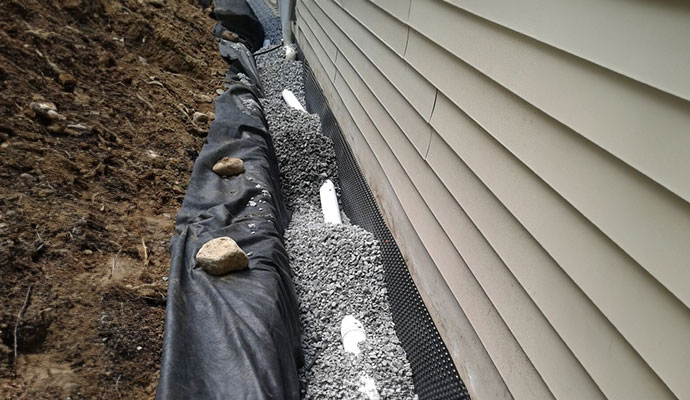
Subsurface systems are designed to capture water that has already entered the soil but has not yet reached the foundation. French drains are the most common example, consisting of a trench filled with gravel and a perforated pipe. These systems are hidden from view, making them popular for high-end landscaping projects where aesthetics are a priority.
Foundation Waterproofing Membranes
Unlike simple damp-proofing, modern waterproofing involves applying a thick, rubberized membrane to the exterior of the foundation walls. This membrane is often coupled with a “dimple board” that creates a small air gap between the soil and the wall. This gap allows any water that reaches the wall to fall straight down into a drain pipe rather than soaking into the concrete.
Internal Perimeter Drains
In cases where exterior excavation is not feasible, professionals may install an internal perimeter drain beneath the basement floor. This involves breaking the concrete around the edge of the room and installing a pipe that leads to a sump pit. While highly effective, this approach is often seen as a last resort because it allows water to reach the foundation before managing it.
Real-world Scenarios For Drainage Management
Real-world applications of how to avoid foundation drainage risk often involve troubleshooting existing failures during a remodel. For instance, a common scenario involves a homeowner noticing a damp basement only after a new patio was installed. The new patio likely changed the surface grading, directing water back toward the house foundation.
Another scenario occurs in older neighborhoods where mature tree roots have invaded and collapsed old clay drainage pipes. In this case, the immediate recovery step is to replace the line with modern, root-resistant PVC. Understanding the second-order consequences, such as how new landscaping might impact existing drainage, is a hallmark of professional planning.
Scenario: The “bowl Effect” Post-landscaping
When new flower beds are built with heavy mulch and plastic edging, they can inadvertently create a “bowl” that traps water against the siding. This trapped moisture often leads to structural rot or termite infestations over time. Homeowners should learn How To Manage Siding Rot: A Professional Restoration Guide to understand the full impact of these drainage-related moisture issues.
Scenario: High Water Table Saturation
In regions with high water tables, the ground may stay saturated for weeks after a heavy rain, regardless of grading. In this situation, a passive French drain may become overwhelmed because there is nowhere for the water to go. The professional solution is an active sump pump system with a battery backup to ensure continuous operation during power outages.
Scenario: Urban Runoff From Neighbors
Many homeowners face the challenge of water flowing onto their property from a neighbor’s higher-elevation lot. Simply blocking the water can lead to legal disputes or localized flooding at the property line. A professional strategy involves installing a “curtain drain” at the property boundary to intercept and redirect the runoff before it enters the primary yard space.
Planning, Cost, And Resource Dynamics
Budgeting for drainage during an exterior remodel requires a clear understanding of both direct labor and hidden material costs. While a simple gutter extension costs very little, a full-scale exterior excavation and membrane application can be significant. Professionals emphasize that these costs are investments in the home’s longevity, preventing much larger structural repair bills later.
| Category | Entry-Level Scenario | Professional Standard | Enterprise/High-End | Key Nuance |
|---|---|---|---|---|
| Grading | Hand-raking soil | Skid-steer leveling | Laser-guided contouring | Soil compaction is vital |
| Gutter Systems | Standard aluminum | Seamless with guards | Copper with high-flow | Downspout exit point |
| French Drains | Shallow gravel pit | Perforated PVC/Fabric | Multi-stage filtration | Slope must be verified |
It is important to remember that “cheap” fixes, like using thin plastic flexible tubing, often lead to operational waste. These tubes can easily be crushed during backfilling or clogged by sediment within just a few years. Investing in professional-grade rigid PVC ensures the system remains functional for decades without needing replacement.
Indirect Costs Of Neglected Drainage
The true cost of poor drainage is often hidden in the accelerated wear and tear of other home components. For example, excessive moisture near the foundation can lead to premature roof failure if the humidity levels in the attic rise significantly. Homeowners frequently Compare Roof Replacement Materials: A Professional Roi Guide without realizing that their underlying moisture issues are the root cause of the damage.
Resource Allocation And Operational Waste
Efficiency in drainage planning involves minimizing the volume of soil that must be moved. By using laser levels to identify the exact path of least resistance, contractors can avoid unnecessary excavation. This reduces both the labor hours required and the amount of debris that must be hauled away from the site.
Tools And Strategies For Professional Implementation
The modern professional toolkit for drainage includes more than just shovels and pipes. Advanced tools like transit levels and soil moisture sensors allow for precise data collection before a single trench is dug. These strategies focus on solving the “Real Problem” rather than just treating the visible symptoms of water pooling.
One primary strategy is “source control,” which aims to catch water as high as possible in the landscape. This might include installing catch basins near the roof’s downspouts or at the edge of a driveway. By managing water at the source, the volume of water reaching the sensitive foundation area is minimized, lowering the overall risk profile.
Precision Grading With Transit Levels
Human eyes are notoriously bad at judging slight slopes over long distances. Professionals use optical or laser transit levels to ensure that a grade maintains a consistent drop of at least 1/4 inch per foot. This precision is what separates a DIY attempt from a professional drainage solution that actually works during a 100-year storm.
Limitations Of Standard Perforated Pipes
Professionals are wary of the “one-size-fits-all” approach to drainage piping. Standard thin-walled perforated pipe can deform under the weight of wet soil or decorative stone. High-performance systems utilize Schedule 40 PVC or triple-wall pipe, which offers the structural integrity needed to remain open and functional under heavy loads.
Risk Landscape And Potential Failure Modes
The risk landscape regarding how to avoid foundation drainage risk is populated by structural, operational, and human errors. A structural error might involve a drain pipe that was installed with a “belly,” or low spot, where sediment can settle. This small error eventually leads to a complete blockage, rendering the entire system useless during a heavy rain.
Operational failures often occur when the exit point of a drainage system becomes obscured by overgrown vegetation or debris. If water cannot leave the system, it backs up toward the foundation, creating a localized flood. Human error typically involves the accidental piercing of a drain line during later landscaping or utility work.
The Taxonomy Of Compounding Failures
Small errors in drainage often compound into systemic disasters. For example, a slightly clogged gutter causes water to overflow directly onto the foundation. This softens the soil, causing the house to settle slightly, which then cracks the foundation wall. The crack then allows the saturated soil’s moisture to enter the basement, leading to mold and structural decay.
Neutral Mitigation Of Technical Pitfalls
To mitigate these risks, professionals recommend the use of “clean-outs”—accessible ports where a plumber’s snake can be inserted to clear clogs. Additionally, installing a “pop-up emitter” at the end of a drain line prevents debris and small animals from entering the pipe while still allowing water to exit freely. These practical steps ensure that the system remains resilient against common failure modes.
Governance And Long-term Maintenance
Mastering how to avoid foundation drainage risk is not a one-time event; it requires ongoing governance and adaptation. A static drainage system can fail as a home’s landscape matures or as neighboring properties change their own grading. Dynamic adaptation involves semi-annual inspections and adjustments to ensure the system still matches the environment.
Maintaining high-quality drainage involves a regular cycle of review, especially after major weather events. By observing how the system performs under stress, property owners can identify minor issues before they become catastrophic failures. This commitment to long-term quality preserves the value of the home and the integrity of the exterior remodel.
- Inspect gutters and downspouts for blockages every spring and fall.
- Check the exit points of all underground drains to ensure they are clear of soil.
- Test sump pumps manually by pouring water into the pit to trigger the float switch.
- Observe the grading around the foundation for any signs of soil settling or erosion.
- Verify that splash blocks or downspout extensions are still in their correct positions.
Adapting To Landscape Maturity
As trees grow, their root systems expand and can put pressure on subsurface pipes. Furthermore, as roots absorb water, they can cause the soil to shrink, potentially altering the grade near the house. A professional review every five years can determine if additional drainage interventions are needed to compensate for these natural changes.
Measurement And Evaluation Of System Success
Success in drainage management is measured by the absence of moisture where it shouldn’t be. Leading indicators include the speed at which surface puddles disappear after a rainstorm and the moisture levels in the soil near the basement walls. Lagging indicators are the long-term absence of foundation cracks, interior dampness, or musty odors in lower levels.
Professionals often use moisture meters to provide objective data to homeowners. By documenting these readings over several seasons, a contractor can prove the effectiveness of the drainage strategy. This data-driven approach removes the guesswork and provides peace of mind that the investment is performing as intended.
Documenting Performance For Future Stakeholders
Keeping a “drainage map” that shows the location of all underground pipes and catch basins is a professional standard. This documentation is invaluable for future homeowners or during subsequent exterior remodels. It prevents the “accidental discovery” of pipes with a backhoe, which can lead to expensive emergency repairs.
Proving Success To Laypeople
The most visible way a professional proves success is through a “hose test” or a “dye test.” By running water into the system and watching it exit at the designated point, they demonstrate that the path of least resistance has been successfully established. This visual confirmation is the gold standard for verifying that the risk has been effectively managed.
Common Misconceptions And Myths
Several myths persist regarding how to avoid foundation drainage risk, often leading homeowners toward ineffective “cheap fixes.” One of the most common myths is that a thick layer of mulch will absorb all the water near a house. In reality, mulch can act like a sponge that holds moisture directly against the siding and foundation, exacerbating rot.
Another misconception is that concrete patios and walkways naturally drain water away from the house. If the soil beneath the concrete was not properly compacted, the slab can “sink” or “pitch” toward the house over time. This creates a permanent channel for water to flow directly into the foundation wall, regardless of how solid the concrete appears.
The Myth Of The Waterproof Basement Sealant
Many believe that applying a waterproof paint to the interior of a basement wall is a permanent solution to drainage issues. However, these sealants only hold back a small amount of pressure. Eventually, the hydrostatic pressure from the outside will cause the sealant to bubble, peel, and fail, as the water must be addressed from the exterior to be truly effective.
Debunking The “deep Pipe” Fallacy
Some assume that the deeper a drain pipe is buried, the better it will perform. In truth, if a pipe is buried too deep without proper gravel backfill, it may never intercept the surface water it was intended to catch. The depth of a pipe must be carefully calibrated to the specific soil layers and the water table of the property.
Ethical, Contextual, And Practical Limits
There are practical and ethical limits to how one can manage drainage on a private property. For instance, it is generally considered unethical (and often illegal) to redirect all of your property’s water directly onto a neighbor’s yard. Responsible drainage design involves managing water on-site or directing it toward municipal storm systems where allowed.
Contextual limits also include the type of soil present. In heavy clay soils, water moves very slowly, making traditional French drains less effective unless they are significantly larger. In these cases, the constraint of the soil type dictates the approach, and a professional must acknowledge when a standard solution will not suffice.
When To Consult A Structural Engineer
There are certain “gray areas” where a standard drainage contractor might not be enough. If a foundation has already begun to shift or if large horizontal cracks are visible, the risk has moved from “drainage management” to “structural repair.” At this point, the practical limit of a drainage-only approach has been reached, and a structural engineer’s expertise is required.
Environmental And Municipal Constraints
Many modern municipalities have strict “permeable surface” requirements to prevent overwhelming city storm drains. This means you may not be allowed to pave over a large portion of your yard to fix a drainage issue. Navigating these constraints requires a balance between personal property protection and broader environmental responsibility.
Logic Synthesis And Final Perspectives
Mastering how to avoid foundation drainage risk is a complex synthesis of hydrological science and practical construction techniques. It requires a move away from reactive “patching” toward a proactive, systemic approach that respects the power of water. By balancing professional judgment with a rigorous systemic process, property owners can ensure their home remains a dry, stable sanctuary.
Ultimately, the most successful drainage strategies are those that are invisible to the eye but perform flawlessly during the most severe weather events. This balance of form and function is the hallmark of a high-quality exterior remodel. Investing in the ground beneath your feet is the most reliable way to protect everything that stands above it.
Frequently Asked Questions
What Is The Most Common Cause Of Foundation Drainage Failure?
The most common cause is negative grading, where the soil or hardscaping slopes toward the foundation rather than away from it. This allows water to pool against the structure, increasing hydrostatic pressure and eventually leading to seepage or structural cracks.
How Often Should I Clean My Underground Drainage Pipes?
Professional standards suggest inspecting and potentially flushing underground lines every two to three years. If your property has many large trees, more frequent cleaning may be necessary to remove silt, debris, or small root intrusions that can cause blockages.
Can Landscaping Plants Help With Foundation Drainage?
While plants can absorb some moisture, they should not be relied upon as a primary drainage solution. In fact, some plants require heavy watering, which can actually increase the moisture levels near your foundation if they are planted too close to the house.
Is A Sump Pump Necessary If I Have A French Drain?
A sump pump is necessary if your property is flat and there is no “daylight” exit point for your French drain to empty into via gravity. In such cases, the French drain collects the water in a pit, and the pump mechanically lifts it to a higher exit point.
How Far Away Should My Gutters Discharge Water?
For optimal safety, gutters should discharge water at least ten feet away from the foundation. This ensures that the water is released beyond the “disturbed soil” zone created during the original construction of the house, where the earth is typically more porous.